
CGP’s revision guides are a long-trusted resource, designed to aid focused revision and pinpoint areas needing extra attention, rather than comprehensive teaching.
These guides, including the New CCEA GCSE Maths Revision Guide, are ideal for catch-up and exam preparation, offering valuable tips and advice.
Available for both Foundation and Higher Tier students, these guides provide crystal-clear notes and worked examples for effective learning.
What is the CGP GCSE Maths Revision Guide?
The CGP GCSE Maths Revision Guide isn’t a textbook aiming to teach all mathematical concepts from scratch. Instead, it functions as a focused revision companion, expertly crafted to help students consolidate their understanding and prepare effectively for their GCSE exams.
As highlighted in reviews, it excels at guiding revision, identifying knowledge gaps, and offering targeted advice. It’s particularly beneficial for students needing to catch up or reinforce learning before crucial assessments like the 2022 and 2023 exams.
These guides are available for both the Foundation Tier and the Higher Tier, ensuring content is appropriately tailored to the student’s level. The guides are “bursting with crystal-clear study notes and worked examples,” providing a solid foundation for exam success. Many students have relied on CGP books for years, attesting to their consistent quality and effectiveness.
Essentially, it’s a strategic tool for maximizing revision efficiency.
Target Audience: Foundation vs. Higher Tier
CGP GCSE Maths Revision Guides are thoughtfully designed to cater to the diverse needs of students pursuing either the Foundation Tier or the Higher Tier GCSE Maths qualification. This differentiation is crucial, as the content and difficulty level vary significantly between the two tiers.
The Foundation Tier guide supports students aiming for grades 1-5, focusing on core mathematical concepts and building a solid base of understanding. Conversely, the Higher Tier guide, as noted in descriptions, is geared towards students targeting grades 6-9, delving into more complex topics and challenging problem-solving techniques.
The “New CCEA GCSE Maths Revision Guide: Higher” specifically prepares students for Higher Tier exams (M3, M4, M7, or M8). Choosing the correct tier guide ensures students are working with material appropriate to their ability and exam level, maximizing their chances of success. Both versions offer clear explanations and worked examples, but the scope and depth of content differ accordingly.

Key Features and Benefits
CGP GCSE Maths Revision Guides boast several key features designed to optimize the revision process. A primary benefit is the provision of “crystal-clear study notes,” ensuring concepts are presented in an accessible and understandable manner. These guides are “bursting” with worked examples, demonstrating how to apply mathematical principles to solve problems effectively.
Furthermore, the guides are specifically tailored for exam preparation, offering targeted advice and tips to enhance performance. The inclusion of an Online Edition provides supplementary resources and interactive learning opportunities.
Reviewers highlight their long-standing reliance on CGP books, emphasizing their value in identifying knowledge gaps and focusing revision efforts. They aren’t designed for initial learning, but rather to refine understanding and build exam confidence. This focused approach makes them an invaluable tool for students seeking to maximize their potential.
Core Content Coverage
CGP guides systematically cover essential GCSE Maths topics, including expressions, powers, roots, formulas, equations, and proportion, providing a structured learning pathway.
The content spans from foundational concepts to more advanced areas, ensuring comprehensive preparation.
Section 6: Expressions
Section 6 of the CGP GCSE Maths Revision Guide meticulously covers algebraic expressions, a cornerstone of GCSE mathematics. This section begins with simplifying expressions by combining like terms, a fundamental skill for manipulating equations.
Students will learn to expand brackets, including those involving negative numbers and variables, building towards more complex algebraic manipulations.
Factorising expressions is also a key focus, enabling students to rewrite expressions in a different form, crucial for solving equations and simplifying fractions.
The guide provides numerous worked examples demonstrating each technique, alongside practice questions to reinforce understanding.
Furthermore, it addresses common errors and misconceptions, helping students avoid pitfalls in their calculations and reasoning. This section prepares students for tackling more advanced algebraic concepts later in the course.
Section 7: Powers and Roots
Section 7 of the CGP GCSE Maths Revision Guide dives into the world of powers and roots, essential components of mathematical fluency. It begins by explaining the rules of indices, covering positive, negative, and zero powers.
Students learn how to simplify expressions involving powers, applying the rules for multiplication, division, and raising a power to another power.
The guide then transitions to roots, explaining square roots, cube roots, and higher roots, and their relationship to fractional powers.
Evaluating roots without a calculator is emphasized, alongside understanding the concept of irrational numbers.
Numerous worked examples illustrate each concept, followed by practice questions to solidify understanding. The section also addresses common mistakes, ensuring students build a strong foundation in powers and roots for future mathematical applications.
Section 8: Formulas
Section 8 of the CGP GCSE Maths Revision Guide focuses on mastering mathematical formulas, a crucial skill for problem-solving. It systematically presents key formulas across various mathematical areas, including geometry, algebra, and statistics.
The guide doesn’t just list formulas; it explains what each symbol represents and when to apply the formula correctly.
Emphasis is placed on rearranging formulas to change the subject, a vital technique for more complex calculations.
Worked examples demonstrate how to substitute values into formulas and calculate accurate results.
Students are encouraged to memorize essential formulas, but also to understand the underlying concepts. Practice exercises provide ample opportunity to apply these formulas in different contexts, building confidence and reinforcing learning for exam success.
Section 9: Equations
Section 9 of the CGP GCSE Maths Revision Guide comprehensively covers solving equations, a fundamental aspect of GCSE mathematics. It begins with the basics – solving simple one-step equations – and progressively builds to more complex multi-step problems.
The guide clearly explains how to isolate variables using inverse operations, ensuring students understand the underlying principles.
It addresses various equation types, including those with brackets, fractions, and variables on both sides.
Worked examples demonstrate each step of the solving process, making it easy to follow and replicate.
Practice questions, with varying difficulty levels, allow students to hone their skills and build confidence. The section prepares students for efficiently and accurately solving equations in exam settings, a key skill for mathematical proficiency.
Section 10: Direct and Inverse Proportion
Section 10 of the CGP GCSE Maths Revision Guide focuses on understanding and applying direct and inverse proportion – a crucial topic for problem-solving.
The guide clearly defines direct proportion, explaining how two quantities increase or decrease together at a constant rate, and illustrates this with practical examples.
It then introduces inverse proportion, demonstrating how one quantity increases as the other decreases, maintaining a constant product.
The revision guide provides step-by-step instructions on how to identify proportional relationships from tables, graphs, and worded problems.
Students learn to calculate unknown quantities using proportional reasoning and to formulate equations representing proportional relationships. Ample practice questions reinforce these concepts, preparing students to confidently tackle proportional problems in their GCSE exams.
Advanced Mathematical Concepts
CGP’s guide delves into challenging topics like quadratic and simultaneous equations, inequalities, and sequences, building upon foundational knowledge for higher-tier students.
These sections offer clear explanations and worked examples to master complex mathematical techniques.
Section 11: Quadratic Equations
Section 11 of the CGP GCSE Maths Revision Guide comprehensively covers quadratic equations, a crucial element of higher-tier mathematics. This section begins by explaining the standard form of a quadratic equation (ax² + bx + c = 0) and introduces various methods for solving them.
Students will learn to solve quadratic equations by factoring, completing the square, and utilizing the quadratic formula – each technique is demonstrated with clear, step-by-step worked examples.
The guide doesn’t just focus on the mechanics of solving; it also emphasizes understanding when to apply each method for maximum efficiency. Furthermore, it explores the relationship between the coefficients of a quadratic equation and its roots, providing a deeper conceptual understanding.
Practice questions with varying difficulty levels are included, allowing students to solidify their skills and build confidence in tackling quadratic equation problems during their GCSE exams.
Section 12: Simultaneous Equations
Section 12 of the CGP GCSE Maths Revision Guide provides a thorough exploration of simultaneous equations, a key skill for problem-solving in mathematics. The guide clearly explains the concept of finding values for multiple unknowns that satisfy several equations concurrently.
It details two primary methods for solving these equations: substitution and elimination. Each method is presented with detailed, worked examples, illustrating the steps involved in a clear and accessible manner.
The guide emphasizes recognizing when each method is most appropriate, enhancing students’ problem-solving strategies. It also covers graphical solutions, allowing students to visualize the intersection points representing the solutions.
Numerous practice exercises, ranging in complexity, are included to reinforce understanding and build proficiency. These exercises prepare students to confidently tackle simultaneous equation problems in their GCSE examinations.
Section 13: Inequalities
Section 13 of the CGP GCSE Maths Revision Guide focuses on inequalities, building upon students’ understanding of equations to explore relationships where values are not necessarily equal.
The guide clearly explains the symbols used to represent inequalities (>, <, ≥, ≤) and how to correctly interpret their meaning. It demonstrates how to solve simple and more complex inequalities, including those involving multiplication and division.
A crucial aspect covered is the impact of multiplying or dividing by a negative number, emphasizing the need to reverse the inequality sign to maintain accuracy.
The section also explores representing inequalities on number lines, providing a visual understanding of the solution set. Practice exercises are plentiful, allowing students to solidify their skills and prepare for exam-style questions involving inequalities.
Section 14: Sequences
Section 14 of the CGP GCSE Maths Revision Guide delves into the world of sequences, providing a comprehensive overview of recognizing patterns and establishing rules.
The guide begins by defining sequences and their terms, then progresses to identifying arithmetic sequences – those with a constant difference between consecutive terms. It clearly explains how to find the nth term of an arithmetic sequence using formulas.
Geometric sequences, where terms are multiplied by a constant ratio, are also covered, with methods for determining the nth term presented in a straightforward manner.
The section includes examples of more complex sequences, such as the square, cube, and Fibonacci sequences, encouraging students to practice pattern recognition. Numerous practice questions, mirroring exam formats, are provided to reinforce understanding and build confidence in tackling sequence-related problems.

Geometry and Measurement
CGP’s guide expertly covers geometrical concepts and measurement techniques, including sets, angles, shapes, and units.
Students will master circle geometry, constructions, Pythagoras, trigonometry, and compound measures with clear explanations.
Section 21: Sets
Section 21 of the CGP GCSE Maths Revision Guide meticulously explores the fundamental concepts of mathematical sets. This section provides a clear and concise introduction to set notation, enabling students to confidently represent and manipulate collections of objects.
Key topics covered include understanding universal sets, subsets, and the various operations performed on sets – union, intersection, and complement. The guide utilizes illustrative examples to demonstrate how to determine the elements within each set and how to apply these operations effectively.
Furthermore, students will learn to represent sets using Venn diagrams, a powerful visual tool for understanding relationships between different sets and solving related problems. The CGP guide ensures students grasp these concepts thoroughly, preparing them for exam questions involving set theory and its applications.
Practice questions and worked solutions are included to reinforce learning and build confidence in tackling set-related challenges.
Section 22: Angles and 2D Shapes
Section 22 of the CGP GCSE Maths Revision Guide provides a comprehensive overview of angles and two-dimensional shapes, crucial for geometrical understanding. This section begins with a detailed exploration of angle types – acute, obtuse, reflex – and their measurement in degrees.
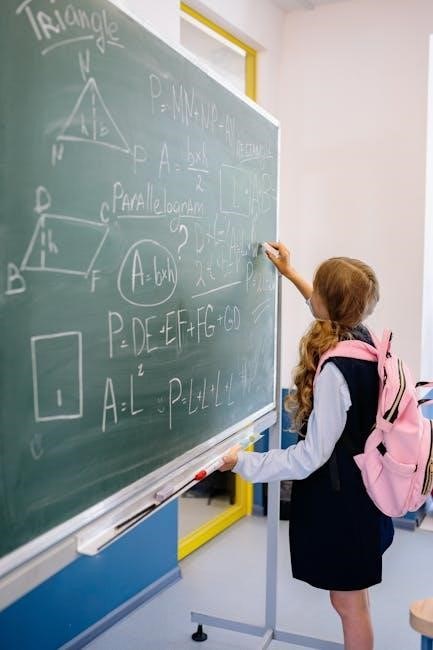
Students will learn about angles formed by parallel lines, including corresponding, alternate, and co-interior angles, alongside rules for calculating angles within triangles and quadrilaterals. The guide clearly defines various 2D shapes, such as triangles, squares, rectangles, parallelograms, and trapeziums, detailing their properties.
Emphasis is placed on understanding the relationships between angles and sides within these shapes, enabling students to solve problems involving perimeter and area calculations. The CGP guide utilizes diagrams and worked examples to illustrate these concepts effectively.
Practice exercises are included to solidify understanding and prepare students for exam-style questions.
Section 23: Circle Geometry
Section 23 of the CGP GCSE Maths Revision Guide delves into the fascinating world of circle geometry, a key component of GCSE mathematics. This section begins by defining essential terminology – radius, diameter, circumference, arc, sector, and segment – providing clear visual representations.
The guide meticulously explains the relationship between the diameter and circumference (πd) and the formula for calculating the area of a circle (πr²). Students will learn about angles subtended at the centre and circumference, including the important rule that the angle at the centre is twice the angle at the circumference.

Furthermore, the CGP guide covers cyclic quadrilaterals and their properties, alongside tangents to circles and the associated angle theorems. Worked examples demonstrate how to apply these concepts to solve geometrical problems.
Practice questions are included to reinforce understanding and build confidence for exam success;
Section 24: Units, Measuring and Estimating
Section 24 of the CGP GCSE Maths Revision Guide focuses on the practical skills of units, accurate measuring, and effective estimation – crucial for real-world problem-solving. The guide begins by outlining standard units for length, mass, and time, emphasizing unit conversions between metric and imperial systems.
Students learn to use appropriate measuring instruments, such as rulers, protractors, and scales, understanding the concept of measurement error and precision. The section provides guidance on taking accurate readings and recording measurements correctly.
Estimation techniques are thoroughly explained, demonstrating how to round numbers to appropriate degrees of accuracy and use approximations to check the reasonableness of answers.
The CGP guide includes practical examples and exercises to develop these skills, preparing students for questions involving real-life scenarios and data interpretation.
Section 25: Compound Measures
Section 25 of the CGP GCSE Maths Revision Guide delves into the world of compound measures, building upon foundational measurement skills. This section clarifies how to calculate and apply rates involving combined units, such as speed, density, and pressure.
The guide meticulously explains the formulas for each compound measure, providing step-by-step examples to demonstrate their application in various problem types. Students learn to rearrange these formulas to solve for different variables.
Emphasis is placed on understanding the relationships between units and ensuring consistency during calculations. The CGP guide offers practical exercises that require students to convert between units and apply compound measures to real-world contexts.
Through clear explanations and ample practice, this section equips students with the confidence to tackle complex problems involving compound measures effectively.
Graphing and Problem Solving
CGP’s section focuses on interpreting and constructing graphs, including straight lines and other types, alongside applying mathematical skills to solve complex problems.
It covers constructions, Pythagoras, trigonometry, and vectors, building a strong foundation for analytical thinking and exam success.
Section 15: Straight Line Graphs
CGP’s coverage of Straight Line Graphs is a crucial component of the GCSE Maths Revision Guide, designed to build a solid understanding of this fundamental concept.
This section meticulously explains how to interpret and construct straight-line graphs, covering key elements like gradients, intercepts, and equations of lines.
Students will learn to determine the equation of a line from its graph and vice versa, mastering the skills needed to accurately represent linear relationships.
The guide provides clear, step-by-step examples demonstrating how to calculate gradients and intercepts, alongside practice questions to reinforce learning.
Furthermore, it explores real-life applications of straight-line graphs, helping students connect mathematical concepts to practical scenarios and problem-solving.
Through detailed explanations and ample practice, CGP ensures students are well-prepared to confidently tackle straight-line graph questions in their GCSE exams.
Section 16: Other Types of Graph
Beyond straight-line graphs, the CGP GCSE Maths Revision Guide extends its coverage to a variety of other graphical representations, broadening students’ analytical skills.
This section delves into understanding and interpreting graphs such as quadratic graphs, cubic graphs, and reciprocal graphs, highlighting their unique characteristics.
Students will learn to identify key features like turning points, asymptotes, and intercepts, enabling them to accurately analyze and sketch these curves.
The guide provides worked examples demonstrating how to determine the equations of these graphs from their visual representation, fostering a deeper understanding.
It also explores transformations of graphs – translations, reflections, and stretches – and their impact on the equation and shape of the curve.
Through clear explanations and practice exercises, CGP equips students with the confidence to tackle diverse graph-related questions in their GCSE examinations.
Section 26: Constructions
The CGP GCSE Maths Revision Guide dedicates a section to geometrical constructions, a fundamental aspect of GCSE mathematics requiring precision and accuracy.
This section meticulously guides students through essential construction techniques using only a compass and straight edge – no protractors allowed!
Students will learn to accurately bisect angles and lines, construct perpendicular lines from a point to a line, and construct loci based on given conditions.
The guide provides step-by-step diagrams and clear instructions, ensuring students grasp the correct procedures for each construction technique.
It emphasizes the importance of showing all construction lines, as these demonstrate the method used and contribute to awarded marks in exams.
Practice exercises reinforce these skills, building confidence and preparing students to confidently tackle construction-based questions in their GCSE assessments.
Section 27: Pythagoras and Trigonometry
CGP GCSE Maths Revision Guide’s section on Pythagoras and Trigonometry equips students with vital skills for solving problems involving right-angled triangles.
It begins with a thorough explanation of Pythagoras’ Theorem, detailing how to find missing side lengths in right-angled triangles using a² + b² = c².
The guide then introduces the three primary trigonometric ratios – sine, cosine, and tangent – explaining their definitions (SOH CAH TOA) and applications.
Students learn how to use these ratios to calculate angles and side lengths in right-angled triangles, applying them to real-world scenarios.
Worked examples demonstrate the correct application of these concepts, while practice questions build fluency and problem-solving abilities.
The section also covers angle of elevation and depression, solidifying understanding and preparing students for exam-style questions.
Section 28: Vectors
The CGP GCSE Maths Revision Guide’s section on vectors introduces students to this important area of mathematics, focusing on their representation and manipulation.
It explains how vectors are represented as column vectors, detailing how to perform vector addition and subtraction geometrically and algebraically.
Students learn to find the magnitude of a vector, understanding its length and direction, and how to represent displacement using vectors.
The guide clarifies scalar multiplication, demonstrating how to scale a vector by a constant factor, altering its length but not its direction;
Worked examples illustrate these concepts, showing students how to solve problems involving vector pathways and geometric shapes.
Practice questions reinforce understanding and build confidence in applying vector principles to various mathematical challenges, preparing them for exams.

Using the Guide Effectively
CGP guides excel at focused revision, identifying knowledge gaps and offering targeted support. Utilize practice questions and online resources for optimal exam preparation.
Combine study notes with worked examples to solidify understanding and boost confidence in tackling challenging mathematical problems.
Revision Techniques with the CGP Guide
Maximizing your revision with the CGP GCSE Maths Revision Guide involves strategic techniques. Begin by actively reading through the concise study notes, focusing on key definitions and formulas. Don’t just passively read; annotate the text, highlighting important information and writing brief summaries in the margins.
Next, diligently work through the example questions provided. Pay close attention to the step-by-step solutions, understanding the reasoning behind each stage. Then, immediately attempt the practice questions that follow, testing your comprehension and identifying areas where you struggle.
Utilize the ‘spot checks’ and quick tests within the guide to regularly assess your progress. These are excellent for reinforcing learned concepts and building exam confidence. Finally, remember that consistent, focused revision is far more effective than last-minute cramming. Break down your revision into manageable chunks and schedule regular study sessions.
The guide is designed to supplement your learning, not replace it, so combine it with other resources and seek help when needed.
Online Resources and Support
CGP enhances its GCSE Maths Revision Guides with valuable online resources, extending learning beyond the printed page. Many guides, including the New CCEA versions, come with access to an accompanying online edition, offering a digital version of the book for convenient study on various devices.
Furthermore, CGP provides additional online support through its website, featuring extra practice questions, answer keys, and downloadable resources. These materials can help reinforce understanding and provide further exam practice.
Students can also benefit from CGP’s online support forums and social media channels, where they can connect with other learners, ask questions, and share revision tips.
These platforms offer a collaborative learning environment and access to expert advice. Remember to check the specific guide for details on accessing the online resources included with your purchase, maximizing your revision potential.